This is to announce that since I recently had a couple surgeries done, I am in debt for the co-pay amounts. Consequently, I had to get a job. So now I work 14 hours a day, 6 days a week, and am not able to work much on my documents. If I get a chance, I am working on updating the Gospel of Mark documents, to show the UBS6 ratings of certainty, and the NA29 readings. If you want, you can download the partially completed files, like markwgrk,pdf
Textus Receptus Matthew
New Upload: The Gospel According to Matthew, A New Translation of the Textus Receptus Greek New Testament.
Alternates verse by verse between the Scrivener 1894 Textus Receptus Greek text and Author’s English translation, with many Textual Criticism footnotes and commentary footnotes and end notes by David Robert Palmer. The critical apparatus is after the pattern of the United Bible Societies’ editions. Contains 674 footnotes and includes the “diamonded” variant readings found in the Tyndale House Greek New Testament, and the updated ratings of certainty according to the UBS 6th Edition (UBS6).
You can download the free PDF here: https://bibletranslation.ws/trans/mattwgrktr.pdf
I also published a printed paperback on Amazon at this link:
https://www.amazon.com/dp/1958612162
Hypergamy and Chivalry
American society is in trouble because fewer than half of young people are getting married. There exists in women a trait called hypergamy. This means that women insist on “marrying above themselves.” So, now that women get more college degrees than men, and make more money than potential men they might date, they do not get married. And men for their part do not care that the women make a lot of money, since in her world, his money is their money, and her money is only hers. This is because women still want chivalry, that is, the man pays for everything. They want a man to play a traditional role, but they themselves have no intention of playing a traditional wife role.
Of course, this deal sucks for men, especially since divorce is disastrous for men in child custody and money matters. Meanwhile in the physical attractiveness realm, 80% of women insist on only the top 1% of men, those who are handsome, are 6+ feet tall, make six figures income. The regular man is left out, and they are giving up on pairing up. The only way to fix the marriage deficit is to give women what they want: that is, men have to make much more money than women do. That means giving the highest paying jobs to men, encouraging married women to stay home with the children. Oh yeah, that’s what the Bible says. https://youtu.be/2LYYncIqzNw
Teach the Younger Women
Titus 2:3-5: ³the older women likewise in reverent demeanor, not tattletales, not given to much wine, teachers of what is good, ⁴so they may instruct the younger women how to be lovers of their husbands, ⁵discreet, chaste, workers at home, kind, submitting to their husbands, so that the word of God not be defamed;”
Are the older women in your church teaching the younger women how to be lovers of their husbands? Or is your church comprised of mostly older people only, or younger people only? If your older women taught the younger women how to be lovers of their husbands, would that be the blind leading the blind? Download this translation of the Bible.
August 2026 Activities
Several things have happened in my life which have curtailed my translation activity. I was renting a room in an old hotel (which did not have a kitchen). The hotel got sold, and the new owners raised my rent from $680 per month to $1,000. I live on Social Security, and that was not doable. In addition, I needed a hip replacement surgery, and the room was upstairs, up some steep awkward stairs which would trip people without hip surgery.
So I moved out of that room, and am living outside in a metal shed with one side open. I tried sleeping outside, but I am in high desert in northern Nevada, and it has been 104 deg. F during the day, and by 5 am in the morning it is 55 degrees. That did not work, so I have been sleeping in my van. I set up an office in the shed, but the glare on my monitor is difficult, and there is wind and dust. In addition, the air is thick with smoke from dozens of brush fires, and I am constantly sneezing, and my eyes are always extremely itchy.
I did undergo the hip replacement, and they said it went well. Now I am also scheduled to have both my eye lenses replaced, since I was developing cataracts. Subsequent to these surgeries, I will have to go back to work in October, a paying job, because Medicare only pays for 80% of the cost of these surgeries, and my 20% copay will be a lot of money.
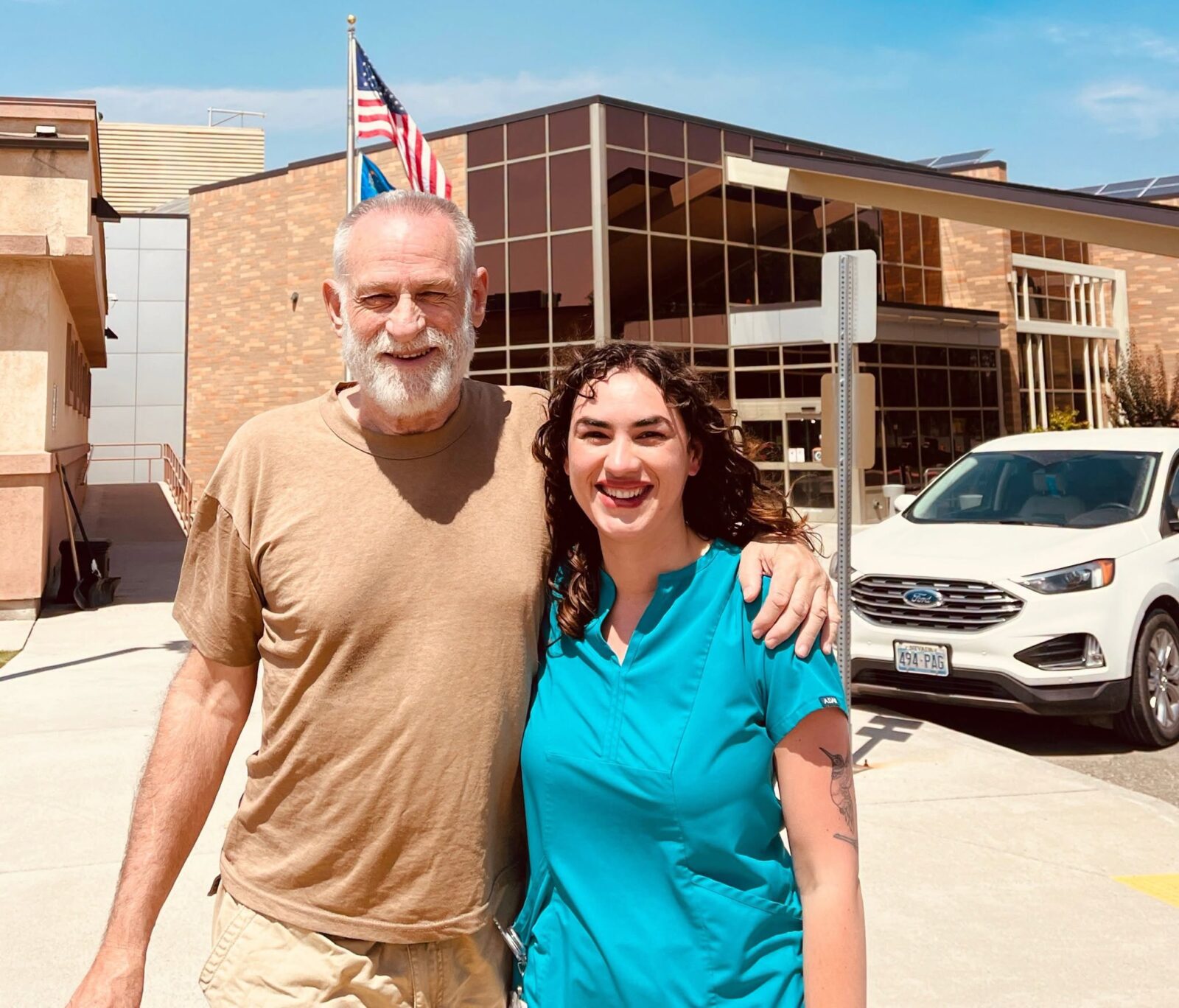
Here is a picture of me when I came out of the hospital after having my stitches from the hip surgery removed. I ran into my daughter Sarah Palmer, who works at the hospital, and was on her lunch break.
Revelation Audio Book
Listen to the text of the Revelation of John on Audible or Kindle:
Audible: https://www.audible.com/pd/Audiobook/B0H9BP15XP
Amazon Kindle: https://www.amazon.com/dp/B0H9BY28S5

New Audible Book
Announcing a new book available on Audible and Kindle: Luke and Acts. I listened to it some, and the AI voice does a surprisingly good job. Here is the link to the Audible Luke and Acts, and to the Kindle Luke and Acts.
Audible: https://www.audible.com/pd/Audiobook/B0H85JD1DY
Kindle: https://www.amazon.com/dp/B0H856L2V6
New Publication
I have published on Amazon a new book, just the works of Luke the beloved physician. That is, the gospel of Luke followed by the Acts of the Apostles. It is fairly large font, 14 point, and without footnotes. You can purchase that here: https://www.amazon.com/dp/1958612154
The file is also available for free download as PDF at: https://bibletranslation.ws/trans/LukeAndActs.pdf